Tamir Ginz’s “ERGA” is Mesmerizing in its Emotional Power
At its Arison Auditorium premiere, Kamea Dance Company’s newest piece turned into a mesmerizing journey of passion, heartbreak, and deep longing.
Even during the preview presentation at the studio in Neve Tzedek, it was clear that Tamir Ginz was working on a deeply personal creation. Back then, a few short excerpts managed to pique great curiosity. However, the full encounter with “ERGA” at the Arison Auditorium revealed a work of immense power. For over an hour, the Kamea Dance Company didn’t just dance the concept of Erga (longing in Hebrew) – they brought it to life as a living, breathing, aching body.
Ginz constructed an entire emotional world on stage – a world seeking to touch a broken love, a world searching for a home after loss. From the very first moment, there was a sense that the stage itself was breathing in unison with the dancers. Everything moved at a uniform emotional frequency; everything sought to reconnect with something lost.
The Wall Split in Two
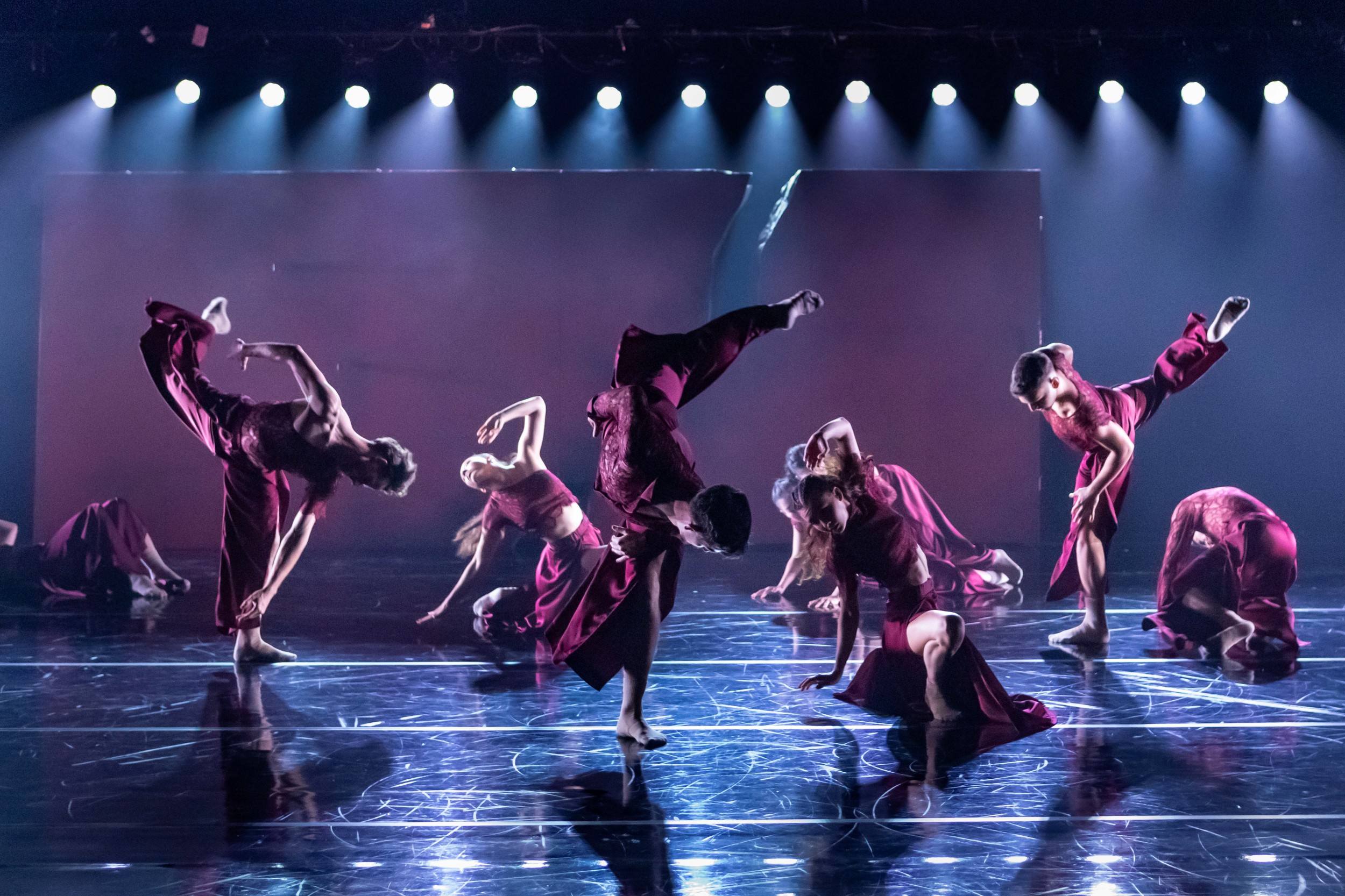
One of the most impressive elements of the performance was Adam Keller’s stage design. Standing in the center of the space was an immense wall reminiscent of an old Arabic stone wall. My mind wandered to the water reservoirs of the ancient well houses in Jaffa – that is exactly what the wall on stage looked like: thick, heavy, and wounded. The wall split into two massive blocks that seemed almost desperate to reconnect. This wasn’t merely scenery; it was another emotional entity within the piece.
The crack between the two parts of the wall became the central symbol of the evening: a yearning for connection, an attempt to heal a fracture, a human longing for closeness. The colors also played a dramatic role here. The red did not stay confined to the wall; it bled onto the floor and throughout the entire space. Light reflections painted the stage in hues of passion, pain, and internal turmoil.
Shai Yehudai’s lighting design was impressive throughout the entire work. White beams of light repeatedly divided the stage into different zones of action. At times, vast group tableaus were created; at others, intimate, almost silent pockets were born. The lighting didn’t just illuminate the dance – it became an additional choreography within the performance.
A Chess Game of Bodies and Movement
Tamir Ginz proves once again why he is one of the most prominent creators in the Israeli dance world. He maneuvers his dancers like a grandmaster in a chess game. Every movement is calculated, every entrance precise, and every shift in the group formation serves the emotional narrative.
Vivid compositions came alive on stage. One moment, a massive human weight stood before the audience; the next, an intimate duet charged with turbulent passion was born. Ginz controls the space almost totally, constantly dismantling bodies and reassembling them.
Yet, it is precisely within this precision that Ginz’s true greatness is revealed. He is no technocrat of movement, nor does he operate his dancers like mechanical tools. From discussions about his work, it is clear how much his creative process relies on deep collaboration with the dancers. Ginz allows them to bring themselves into the piece – not just to execute a movement, but to live it from within.
You can really feel this throughout “ERGA”. Every body on stage carries a personal emotional weight. Every encounter feels authentic, exposed, and vulnerable. Even during the grand group moments, a tender humanity is preserved within the precise choreographic structure.
A Personal Movement Signature
Throughout the piece, movement gestures deeply identified with Ginz’s world also emerged. For those familiar with his previous works, moments were revealed that felt like a direct echo of past creations. One of the most prominent was the group of dancers walking toward the light – a movement sequence highly reminiscent of “Bamidbar Devarim”.
Over the years, Ginz has tended to preserve certain movement characteristics – a sort of personal signature that returns in various iterations from piece to piece. This is not a recycling of ideas, but a consistent choreographic language. It is a language that allows one to immediately recognize his artistic signature.
These gestures functioned here like the internal memory of the creator – additional layers within the emotional world of “ERGA”. For long-time followers of Kamea, an extra layer of excitement was created: a sense of reunion with movement imagery already embedded in the memory of both the company and the audience. The immense power of “ERGA” lies precisely in these transitions: between the crowd and solitude, between love and distance, and between the desire for contact and the fear of closeness.
The word “erga” expresses longing, a deep yearning, and a craving for something out of reach. This feeling is present throughout the entire work – in every glance, every touch, and every sudden distance created between the bodies on stage. Ginz did not settle for merely illustrating the word “Erga”; he translated it into a complete body language. The bodies on stage do not just dance; they search, yearn, attract, repel, and reconnect.
The Soundtrack by Gil Nemet
The soundtrack created by musician Gil Nemet accompanies the piece throughout its entire duration with immense power. Nemet did not just write music to accompany dance; he constructed an entire emotional mechanism operating from within the work itself.
The music shifts between internal tension and rhythmic pulses, between contemplative moments and dramatic outbursts. At times, echoes reminiscent of Mozart’s Requiem could be heard; at others, electronic sound layers emerged, creating a sense of constant restlessness.
The collaboration between Ginz and Nemet proves just how much the two speak the same artistic language. The music drives the dancers forward. It builds tension. It creates an internal breath. At times, it seems to animate the stage itself.
A Flagship Piece for the Kamea Dance Company
“ERGA” is already shaping up to be one of the most impressive works by the Kamea Dance Company in recent years. After watching the premiere, it is impossible to ignore the power the company managed to generate on stage.
The company’s sixteen dancers became a single organic entity here. While each maintained a distinct personal identity, together they created a mesmerizing and precise movement language.
This is not just a contemporary dance piece; it is a total work of art – a creation where movement, light, space, color, and music coalesce into an exceptionally powerful emotional experience.
For over an hour, “ERGA” was not merely performed on stage; it permeated the entire space, leaving the audience with a lingering sense of longing long after the final applause.