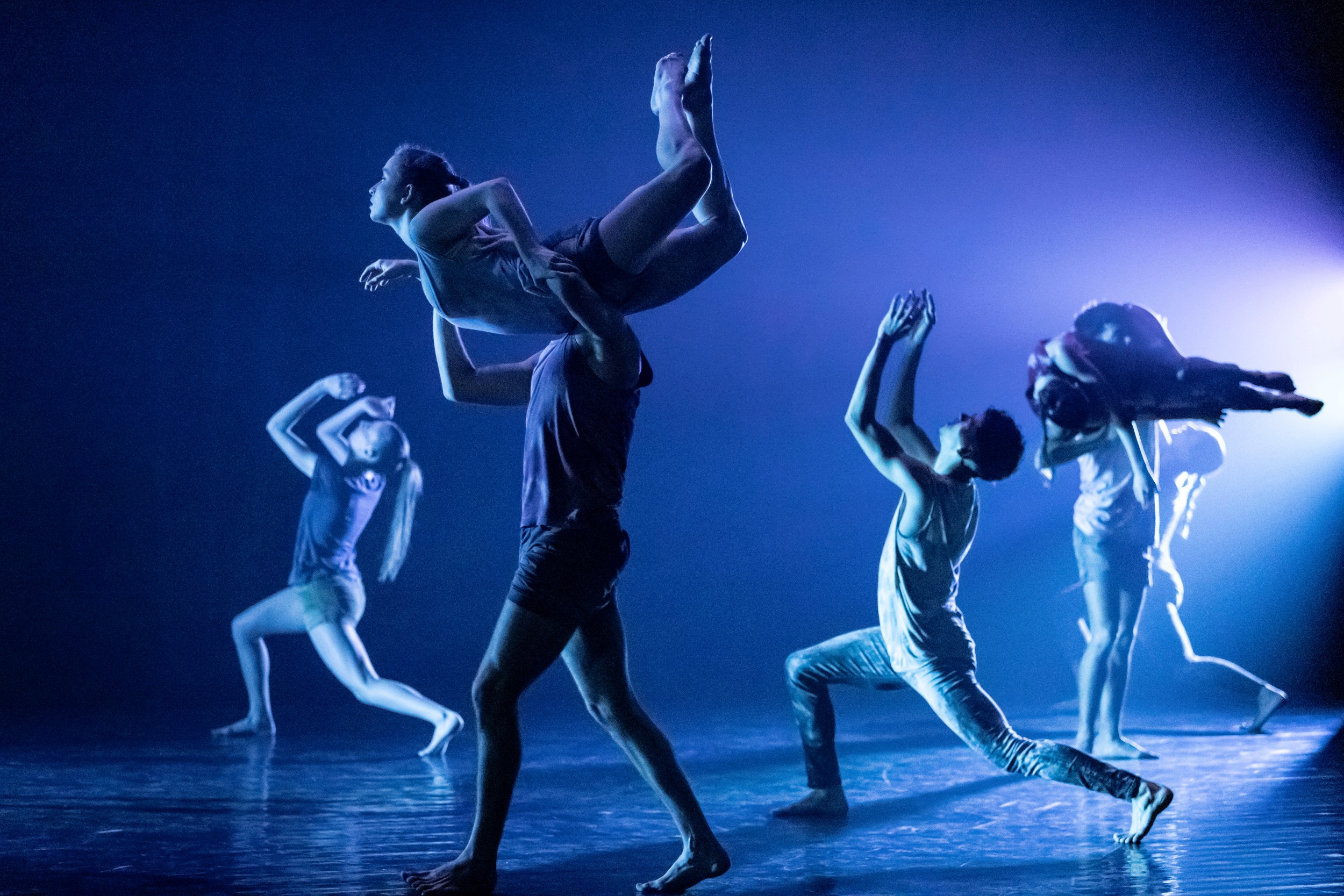
“Gray” is a performance that penetrates the soul. It is easy to see that this dance was born from the fractures within Israeli society in recent years – war, reconciliation, conflict, and mutual support. Gray exists in a thousand shades.
A Language Built Over Time
For more than two decades, Kamea Dance Company has established itself as one of the most consistent and clearly identified companies in Israeli dance. Since its founding in Beer-Sheva in 2002, Kamea has operated from a space that is far from taken-for-granted in the local dance scene: a geographic periphery from which artistic centrality is created. This is a move that is not merely logistical or institutional, but one that shapes the very language of the body. Kamea is not a company that seeks to blend into the dominant discourse, but rather to articulate an independent, direct voice – one that does not shy away from drama, emotion, or positioning the body as a site of struggle.
At the heart of this work stands Tamir Ginz, the company’s artistic director and principal choreographer, who is also, to a large extent, the architect of its identity. Ginz’s creations consistently move between expansive musical structures and charged human situations: faith, community, desire, conflict. In contrast to the minimalist or conceptual trends that characterize parts of contemporary Israeli dance, Ginz chooses a dramatic body – one that does not turn inward but reaches outward toward the viewer, at times almost demanding. This is not a fashionable choice, but it is a consistent one, and it is what gives Kamea its distinctive character and loyal audience.
The company’s repertoire, including expansive works such as “Carmina Burana” and “Matthäus Passion 2727”, reflects a continuous attraction to material with historical, spiritual, or mythical weight. Even when Kamea turns to more intimate works or hosts other choreographers, there is always a sense of commitment to the body as a site of drama. The body is not only a carrier of form but also a bearer of memory, weight, and responsibility.
Lightness as a Foreshadowing
The current evening opens in a completely different place. “Cherry Pink and Apple Blossom White” by Itzik Galili offers a light, playful, almost mischievous beginning. On stage appears a couple who resemble two elegant clowns, as if pulled from a silent film or a modern circus. She is seductive, he is enticed, and together they create a physical dialogue of dance stunts and acrobatics, precise yet full of charm.
The rhythmic and beloved music carries the duet over movement that does not strive to impress, but rather enjoys itself. This is an exhilarating and comic dance that flirts with the audience, creating a sense of lightness, even relief. There is a clear, almost naïve role-playing at play, evoking smiles without ever sliding into simplicity.
It is precisely this relative simplicity that retrospectively highlights the dramatic choice of the evening as a whole. This opening lays the groundwork through contrast, without declaring it outright. It generates a sense of security, perhaps even the illusion of a purely entertaining evening – an illusion that is soon unsettled.
Gray as an Existential State
The transition to Tamir Ginz’s “GRAY” is sharp and clear. If the first work operated through color, rhythm, and play, here gray takes over everything. There is no black or white. No resolution. Gray is not a compromise, but a continuous existential state. It is the color of smoke that covers, blurs distinctions, dulls perception, and overwhelms the senses.
It is evident that “GRAY” is a product of recent years. Years of war, trauma and post-trauma, recovery and collapse, ongoing conflicts, and a deep need for mutual support in order to keep moving. This is a work that does not respond to a single event but to an ongoing reality of emotional overload – one without a clear climax or satisfying catharsis.
The dancers in “GRAY” are not presented as heroes or victims. They are bodies subjected to circumstance. Sometimes they hold one another, sometimes they push, sometimes they simply move side by side without knowing where to go. The group is neither a refuge nor an enemy. It exists on the edge: not falling apart, yet not solidifying into a stable community. The individual does not stand out as an anomaly, but as someone struggling to remain visible, to avoid being swallowed or disappearing.
Gray is revealed here as a social state no less than an emotional one. It is a dance about living within a space where boundaries are unclear, where there are no unequivocal answers, and where movement itself is sometimes the only way to remain present.
Voice, Text, and Body
One of the striking vocal choices in the work is the use of recorded text, with lines such as “The king has no crown, the queen has no home.” Instead of poetry, the voice of the poet Lea Goldberg herself is heard. This choice strips the words of any comforting lyricism, leaving them exposed, almost cutting. The voice does not caress the movement but exists alongside it, at times even colliding with it.
It is a voice that does not seek to explain, but to resonate. It does not resolve the gray, but deepens it. A constant tension arises between voice and body: the body does not illustrate the text, and the text does not dictate the movement. Both exist in parallel, like thought and feeling that never fully converge.
In terms of movement, a shift in range is also evident. Ginz, who in every work expands and modifies the limits of his language, does so here in a particularly striking way. If “Matthäus Passion” and “Wild Awake” marked different poles in his oeuvre, here even the poles themselves seem to dissolve. Movement oscillates between strength and softness, between aggression and hesitation, between eruption and quiet collapse.
It is a dance that unsettles without raising its voice. It moves with force, yet allows moments of fragility. This may be Ginz’s closest encounter with the psyche as it is experienced today – wounded, exposed, yet still insisting on movement.
Light, Space, and What Remains in Shadow
Alongside movement and voice, the visual language of “GRAY” plays a crucial role. The use of light and lighting design is precise and complex. Light does not simply illuminate; it cuts, it divides, and at times refuses to fully reveal. Sometimes it flows from one side only, leaving part of the stage in shadow and part bathed in intense, almost blinding light.
This division creates a fragmented conscious space. Not everything is visible, not everything is hidden. Some areas are fully present, others remain in shadow, like unspoken thoughts or emotions left without full expression. Light washes over the stage and the dancers, yet also emphasizes the boundaries of what can be seen and understood.
Within the context of Kamea, “GRAY” is not just a new work but an artistic stance. It does not deny the language built over the years, but chooses to fracture it from within. Gray here is not fatigue, but acknowledgment – an acknowledgment that the world, the body, and the community no longer operate according to clear distinctions. Dance, like life, today must bear complexity without rushing to offer resolution.
It is an evening that begins with a smile and ends with a prolonged dwelling in uncertainty. An evening that asks the viewer not only to watch, but to stay. Within the gray. The ending is particularly powerful. It leaves the audience breathless. You will have to go and see it to understand what it is about.