A Breeze Before the Dive: “GRAY” by Kamea and Tamir Ginz at Suzanne Dellal Center
A dance evening that opens with a surprising comic duet and continues into a striking work on fracture, prayer, and hope within a gray reality.
At first glance, we arrived at Suzanne Dellal Center to dive into another new work by choreographer Tamir Ginz and his company, Kamea, from Be’er Sheva. But the evening begins with a complete surprise. Yes, we knew there would be an opening act, but we could not have imagined how full of life, humor, and lightness it would be, and how it would serve as a refreshing, almost mischievous prelude before entering the calculated, complex, and painful world of the main piece.
Cherry Blossom Bloom
Even before Kamea took the stage, dancers Joshua Dans and Noa Pasman (members of Kamea Dance Company) performed a short duet to a choreography by Itzik Galili, set to “Cherry Pink and Apple Blossom White” by Perez Prado.
The 1950s hit, inspired by Cuban rhythms, received here a smart and liberated stage interpretation. Dressed in dark trousers and a white buttoned shirt, the two offered a comic duet that blended Latin dance movements with a contemporary vocabulary, musical precision, and subtle humor. In just eight minutes, a sharp, slightly sexy, absurd, and charming stage moment emerged, earning applause and leaving a clear impression – one that made you wish there were more moments like this in dance evenings.
The original melody, accompanied by trumpet fanfares, has other versions, some performed on acoustic guitar.
A Spectrum of Gray
Afterwards, the evening shifted to its main work, “GRAY”, Tamir Ginz’s new creation. A work born from recent years’ events, it invites the audience to reflect on a reality where there is no longer black or white – only dense gray and heavy air. Ginz addresses the rifts between people, the struggle over land and identity, in a place where demagoguery and incitement stir passions and leave souls fractured. This is a work about people living in constant instability, trying, sometimes stubbornly, to grasp a glimmer of hope amid ongoing pain.
It is hard to pinpoint a single moment from which it all begins, but one can step back and see “GRAY” as a response to a cumulative sequence of events: the outbreak of COVID-19, the hazy years of internal and political division in Israel, and the shock that shook reality with the outbreak of war on October 7th. All these resonate in the dancing body, even without being explicitly stated.
Movement Patterns
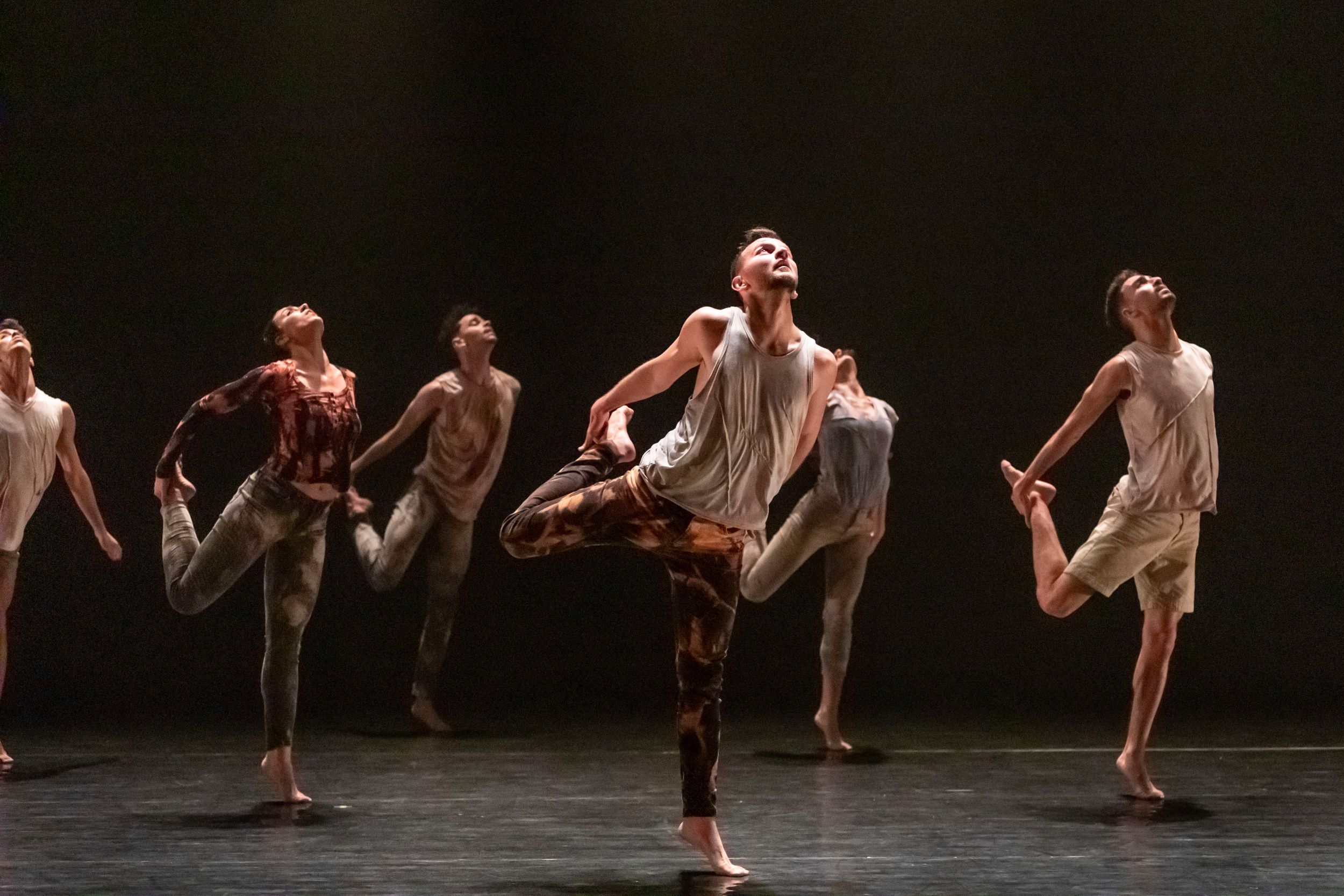
The performance is divided into several sections and dance stories, with Ginz emphasizing the tension between the collective and the individual. On stage, ten dancers move between solos, duets, and trios, and broader group work, almost like symbolic grid-like games in which every movement shifts the whole picture. Some of the movement material is familiar from Ginz’s previous works, and his signature language emerges clearly. One can recognize recurring movement patterns, group dynamics, and stylistic traits that have accompanied his creations over the years.
One of the strong recurring motifs is the dancers gathering toward a hidden source of light at the edge of the stage. A unified, almost prayerful movement: arms raised, palms open in supplication, as if seeking a response from an undefined higher power. Interspersed are duet sections that depict parallel, identical, or completely opposite relationships, sharpening the sense of fracture and distance. The carefully designed lighting is not merely a frame but an active part of the drama, as is the soundtrack by Max Richter and Avi Belli, edited and arranged by Miki Fetish, which deepens the atmosphere and guides the emotional journey.
Cries of a Beloved Land
One of the most dramatic moments occurs when the fragile, aged voice of Leah Goldberg is heard reading her poem “My Beloved” from the collection “From the Poems of My Beloved Land”, published in the early 1950s. Written against the backdrop of her early life in Israel – a time of loneliness, yearning, and disappointment – the poem offers a personal and painful perspective on love and belonging, between the individual and the land, between identity and disillusionment. It speaks of a bond from which there is no escape, of loyalty to pain, and of recognition of suffering as an inseparable part of the relationship. In this moment, the poet’s personal voice meets the wounded collective dance on stage, creating a pause for reflection and emotional resonance that naturally aligns with GRAY’s journey.
“GRAY” is a journey that moves between prayer and grief, between the group and the individual, between fracture and the attempt to mend it. Not every moment is surprising, but the work carries honesty, urgency, and relevance that are impossible to ignore. And when recalling the small duet that opened the evening – this fleeting moment of lightness and smile – the choice to start the performance this way becomes even clearer: a short breeze before the dive into gray.