ERGA: A Requiem for Love | A dance performance by the Kamea Dance Company, an intimate experience of longing, passion, and solitude.
The Kamea Dance Company presents “ERGA”, a new work by Tamir Ginz, which places a single, fundamental yet complex emotion at the center of the stage: longing. Not the kind that relies on nostalgia, but rather one born out of the present moment itself – out of relationships that are built, fractured, and attempt to persist despite everything.
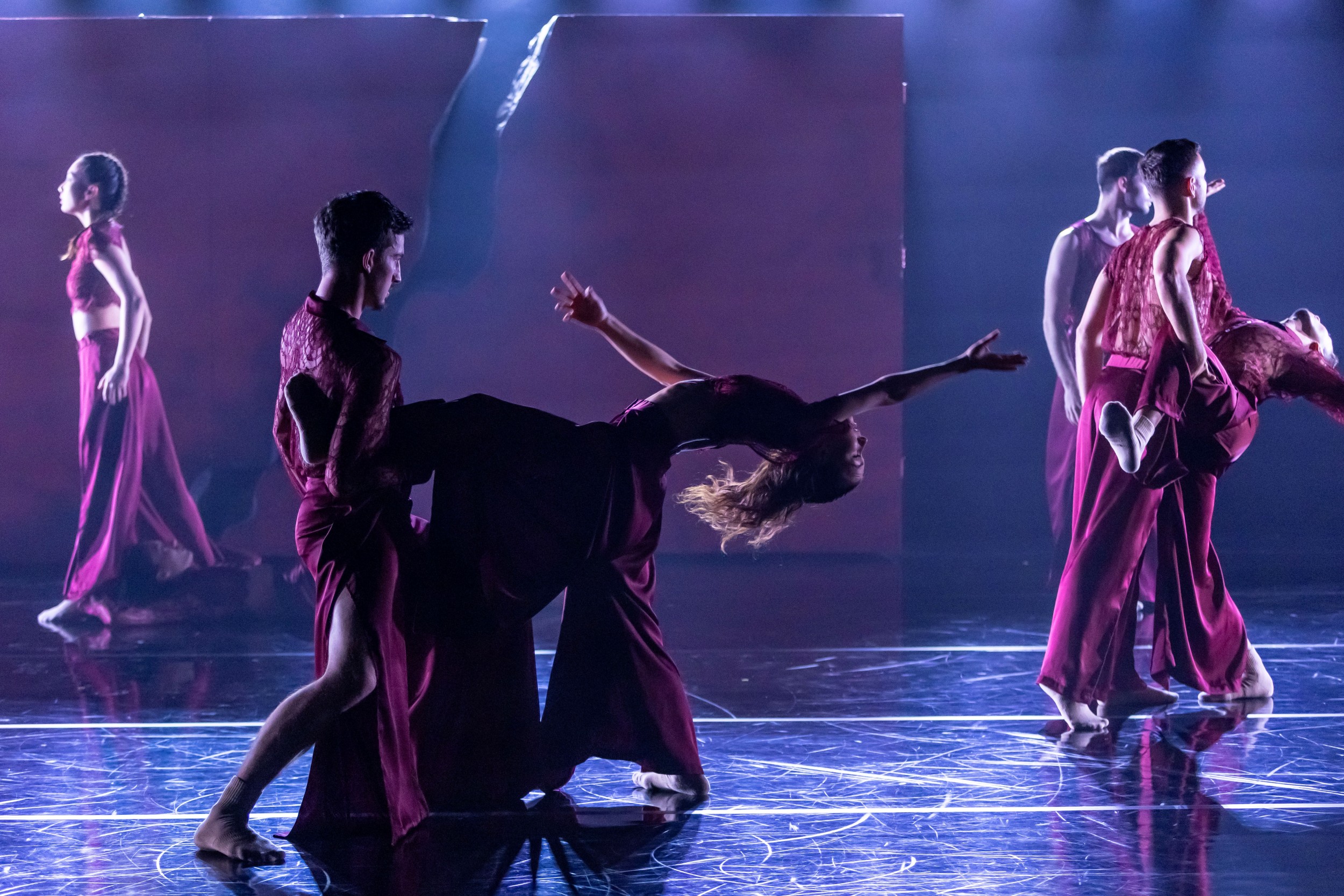
This is a work that builds a living, breathing emotional world. From the very first moment on stage, a powerful sense of presence is established; something is constantly happening beneath the surface. The dancers move between tenderness and collapse, between a pull toward closeness and an almost instinctive distancing. It seems as though every movement is born out of an attempt to hold on, just a moment before what stands in front of you disappears or changes uncontrollably.
Within this, the body itself becomes the primary language of the work. It speaks what cannot be said in words: the silences that linger after a confrontation, the gaps that open up between two people, and that feeling of wanting to be close alongside a very real fear of closeness itself. There are moments when it seems the body is trying to say “stay”, even when everything else is already moving toward separation.
Ginz builds “ERGA” as an open, almost completely exposed emotional space. It is a journey that shifts between passion and distance, between an attempt to hold onto a connection and the realization that it is changing or falling apart mid-motion. This tension remains unresolved throughout the performance; on the contrary, it deepens, as if the piece refuses to soothe itself or the spectator.
One of the central elements in the work is the group itself, which sometimes functions as a single, massive body, and at other times dismantles into individuals isolated within the space. The transition between these states sharpens the sense of emotional instability that accompanies the entire piece – between togetherness and solitude, between shared presence and quiet disintegration.
At the center of the stage stands a wall split in two. Ostensibly a piece of scenery, in practice it becomes a true emotional anchor. It creates a vivid image of something that was once whole and is no longer. The dancers move around it repeatedly, as if testing whether it is still possible to touch what has been broken, or at least remain close enough to it so as not to lose it completely. At times, it seems to be not just a wall, but a physical memory of a connection.
Shay Yehudai’s lighting also contributes to building this world. It does not merely illuminate the stage, but redraws it at every moment: areas open and close, spaces shift, and the feeling is one of constant movement between exposure and withdrawal, between clarity and emotional fog. The light itself becomes almost another character in the performance.
The music by Gil Nemet accompanies the work like an additional layer of emotion, but also like an internal engine driving it forward. At times it is nearly silent, almost hidden, and at others it bursts forth with a power that sharpens the drama and pushes the stage forward. This is not music that merely accompanies the work, but rather the shared breath of everything taking place on stage.
Throughout the work, the precise execution of the Kamea Dance Company itself is also evident. The dancers bring a combination of high technical mastery and a deeply sensitive human presence to the stage. Each of them appears to carry their own internal story, while simultaneously being part of a larger system that moves together and breaks together. Within this precise structure, room for vulnerability remains.
“ERGA” leaves the spectator within the tension itself – between closeness and distance, between love and loss, between what was and what might yet be. It is a tension that is not resolved, but continues to resonate long after the stage goes dark.
“ERGA” does not explain emotion; rather, it allows it to be felt in real-time on stage, through the body, and then leaves it there – open, without a resolution.